menu
00
Pin
WHERE CONTROL AND CONFIDENCE ARE BUILT, ONE TURN AT A TIME.
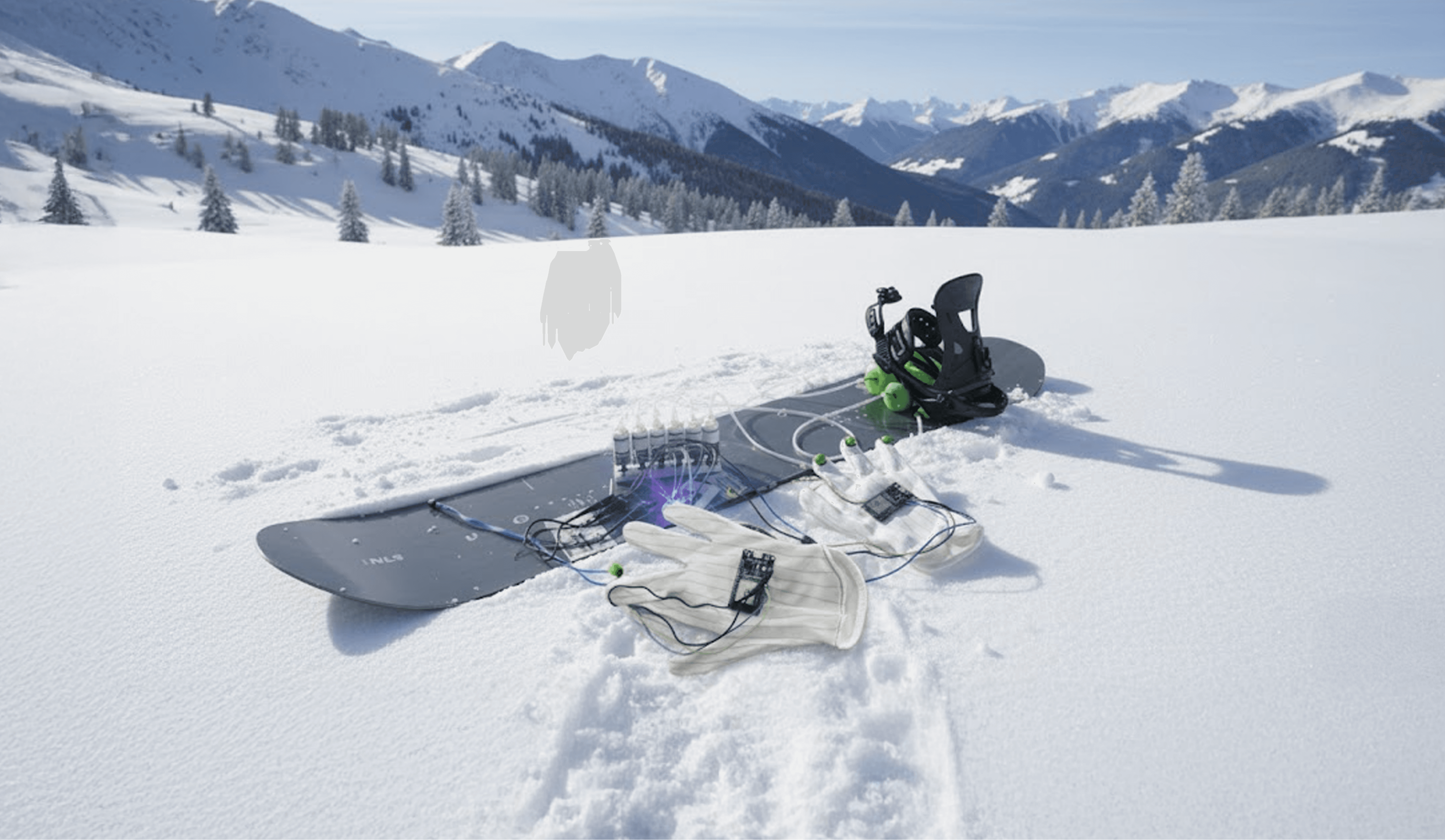
The Adaptive Snowboard Assist System reimagines how beginners learn snowboarding by transforming fear into feedback and uncertainty into control. Through a combination of a variable-angle board base and wearable gesture input, the system provides real-time physical assistance and intuitive guidance—much like a coach who is always by your side. By helping riders feel the relationship between edge angle, balance, and speed, the system supports beginners through their most vulnerable learning phase, gradually reducing intervention as confidence grows, and empowering them to ride independently with safety and trust.
problem
Beginner snowboarders often give up due to fear of losing control, caused by unstable balance, unclear speed feedback, and the lack of continuous, personalized guidance during early learning stages.
solution
Design an adaptive snowboarding assist system that provides real-time, intuitive feedback on balance and speed, helping beginners build confidence, reduce fear, and learn safely through progressive, self-guided practice.
How might we support beginner snowboarders with real-time, intuitive guidance that reduces fear, builds trust in body control, and enables safe, self-paced learning without constant instructor supervision?
This project explores how gesture interaction can support snowboard training and postural control. By integrating pneumatic air bladders beneath the bindings and sensor-embedded gloves as gesture input devices, the system enables real-time balance adjustment through air pressure modulation. Riders can intuitively control edge tilt, toe and heel balance, or stability levels via hand gestures. Designed for beginners and rehabilitation scenarios, the setup simulates on-slope feedback without external instructors—bridging the gap between physical motion learning and human–machine adaptive response.
How might we support beginner snowboarders with real-time, intuitive guidance that reduces fear, builds trust in body control, and enables safe, self-paced learning without constant instructor supervision?
This project explores how gesture interaction can support snowboard training and postural control. By integrating pneumatic air bladders beneath the bindings and sensor-embedded gloves as gesture input devices, the system enables real-time balance adjustment through air pressure modulation. Riders can intuitively control edge tilt, toe and heel balance, or stability levels via hand gestures. Designed for beginners and rehabilitation scenarios, the setup simulates on-slope feedback without external instructors—bridging the gap between physical motion learning and human–machine adaptive response.
How might we support beginner snowboarders with real-time, intuitive guidance that reduces fear, builds trust in body control, and enables safe, self-paced learning without constant instructor supervision?
This project explores how gesture interaction can support snowboard training and postural control. By integrating pneumatic air bladders beneath the bindings and sensor-embedded gloves as gesture input devices, the system enables real-time balance adjustment through air pressure modulation. Riders can intuitively control edge tilt, toe and heel balance, or stability levels via hand gestures. Designed for beginners and rehabilitation scenarios, the setup simulates on-slope feedback without external instructors—bridging the gap between physical motion learning and human–machine adaptive response.
How might we support beginner snowboarders with real-time, intuitive guidance that reduces fear, builds trust in body control, and enables safe, self-paced learning without constant instructor supervision?
This project explores how gesture interaction can support snowboard training and postural control. By integrating pneumatic air bladders beneath the bindings and sensor-embedded gloves as gesture input devices, the system enables real-time balance adjustment through air pressure modulation. Riders can intuitively control edge tilt, toe and heel balance, or stability levels via hand gestures. Designed for beginners and rehabilitation scenarios, the setup simulates on-slope feedback without external instructors—bridging the gap between physical motion learning and human–machine adaptive response.
year
2024
year
2024
year
2024
year
2024
timeframe
3 month
timeframe
3 month
timeframe
3 month
timeframe
3 month
tools
Haptic Gesture Input | Human–Machine Balance|Arduino
tools
Haptic Gesture Input | Human–Machine Balance|Arduino
tools
Haptic Gesture Input | Human–Machine Balance|Arduino
tools
Haptic Gesture Input | Human–Machine Balance|Arduino
category
Personal Project
category
Personal Project
category
Personal Project
category
Personal Project
01 RESEARCH
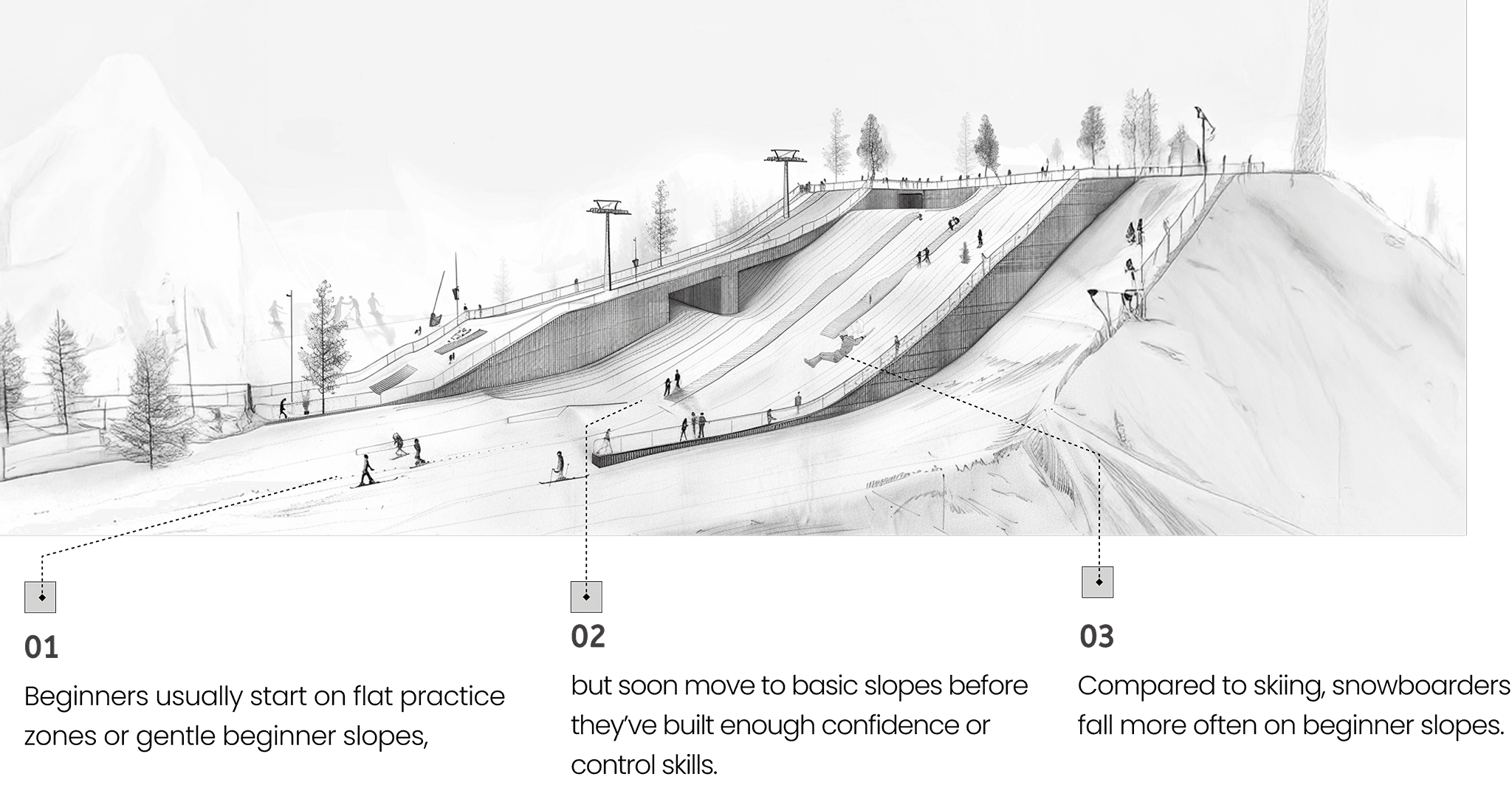
Typical Slopes for Beginners (Scenario)
Typical Slopes for Beginners (Scenario)
Typical Slopes for Beginners (Scenario)
Typical Slopes for Beginners (Scenario)
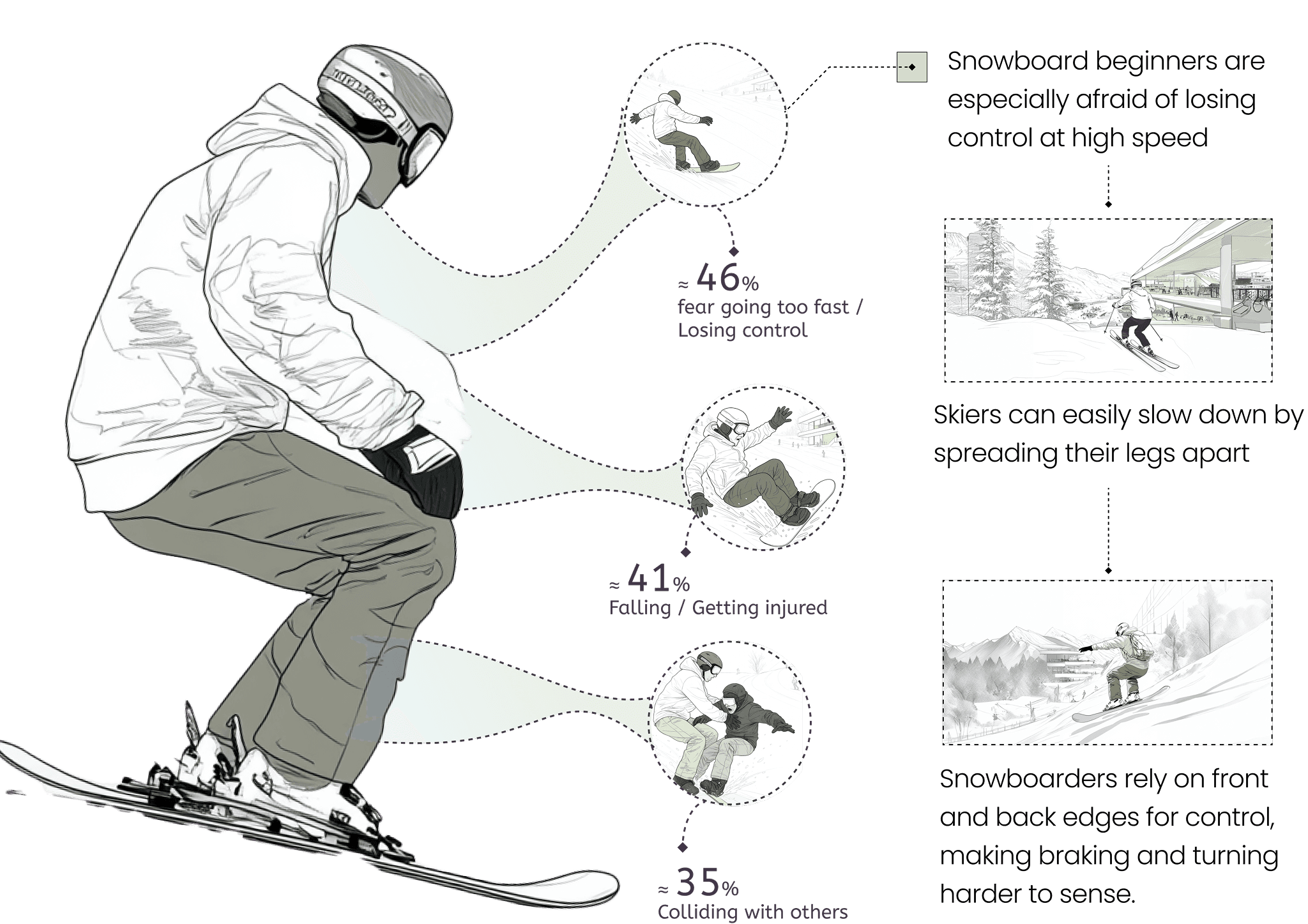
Learning and Lesson Participation
Many beginners, when first trying skiing, face the choice of whether to take lessons or not.
Learning and Lesson Participation
Many beginners, when first trying skiing, face the choice of whether to take lessons or not.
Learning and Lesson Participation
Many beginners, when first trying skiing, face the choice of whether to take lessons or not.
Learning and Lesson Participation
Many beginners, when first trying skiing, face the choice of whether to take lessons or not.
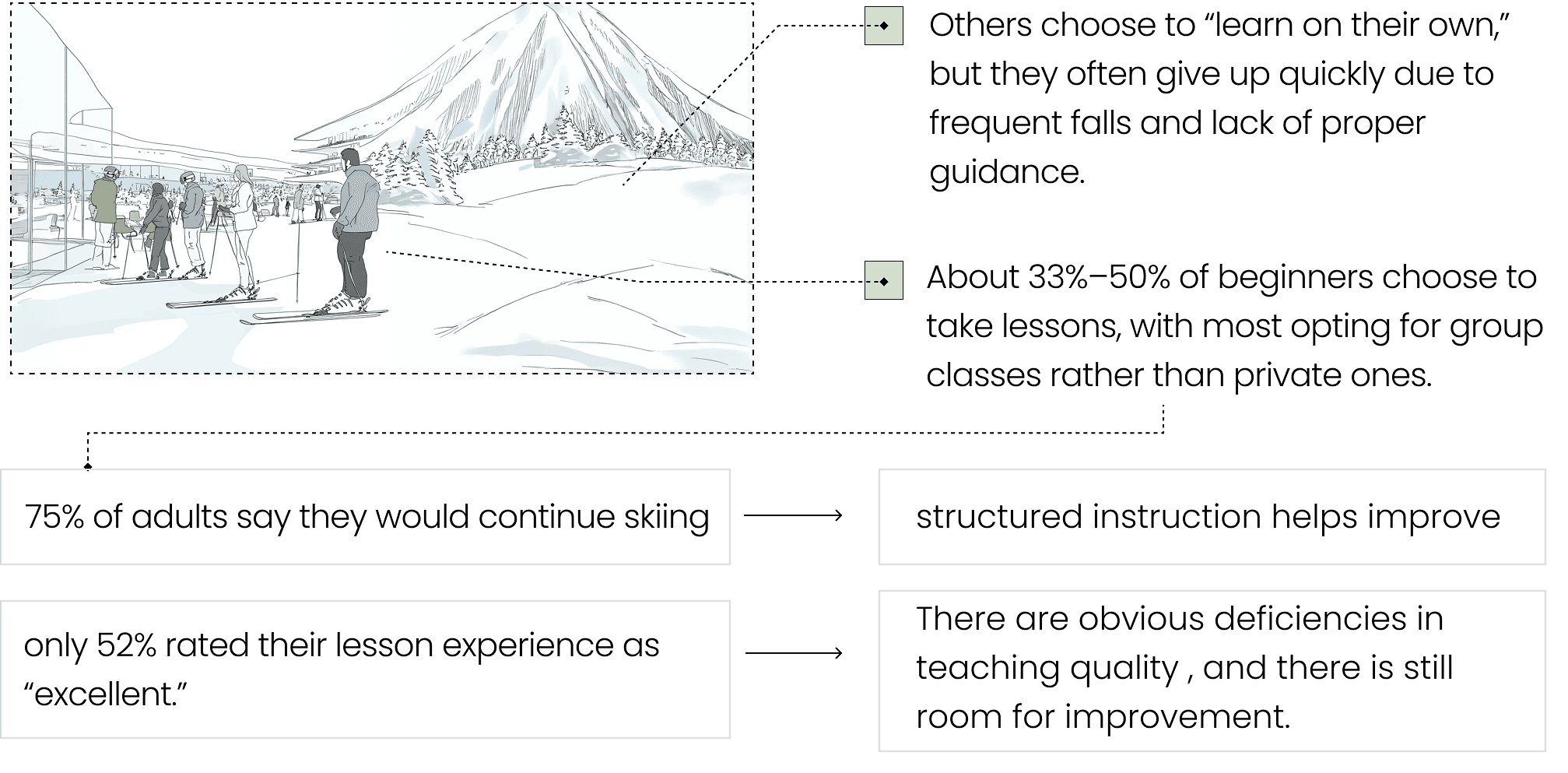
Beginner Pain Points Summary
Combining fear factors and learning conditions, three key barriers emerge:
Beginner Pain Points Summary
Combining fear factors and learning conditions, three key barriers emerge:
Beginner Pain Points Summary
Combining fear factors and learning conditions, three key barriers emerge:
Beginner Pain Points Summary
Combining fear factors and learning conditions, three key barriers emerge:
02 Research
Typical Slopes for Beginners (Scenario)
Typical Slopes for Beginners (Scenario)
Typical Slopes for Beginners (Scenario)
Typical Slopes for Beginners (Scenario)
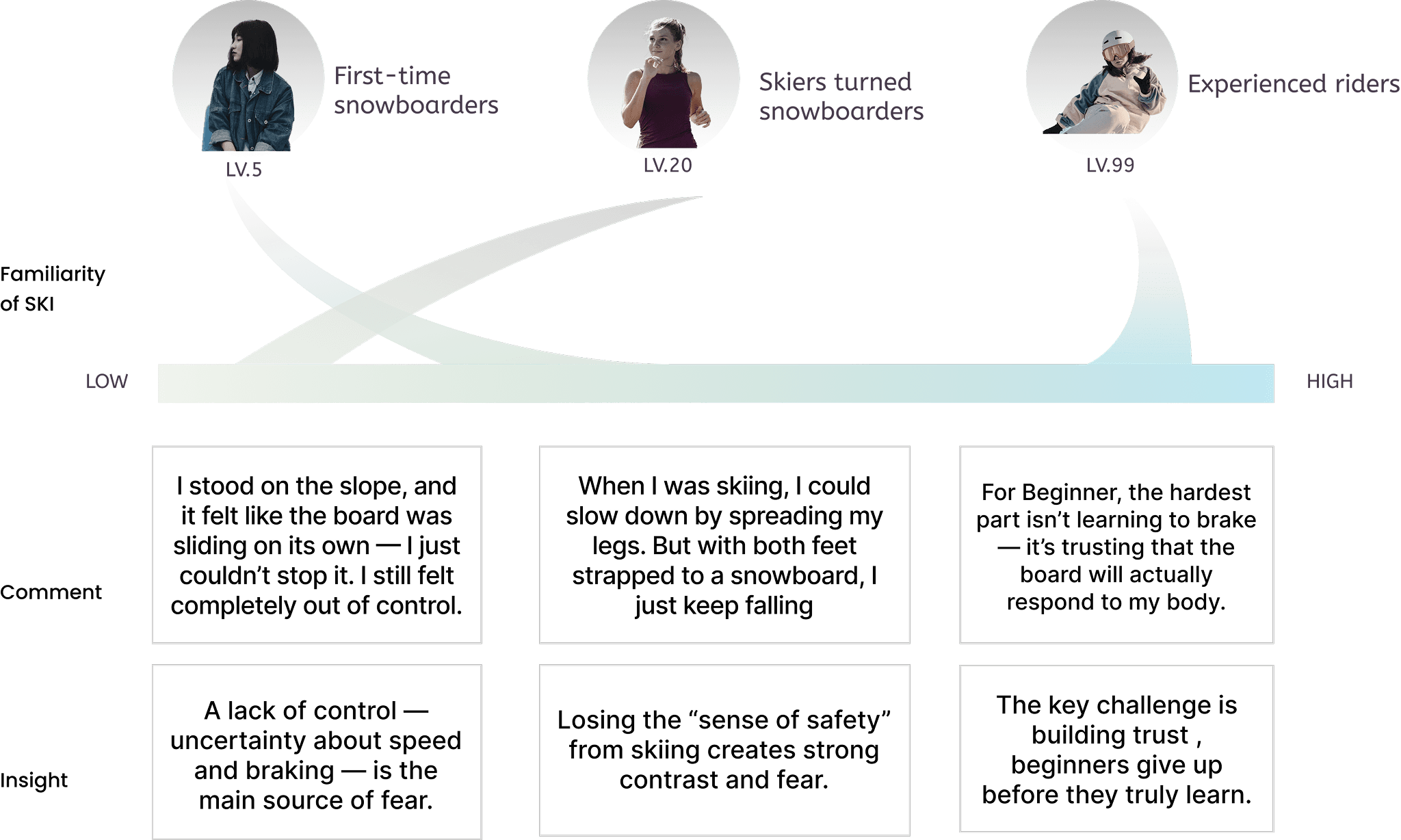
Real Voices from Beginners
Whether it’s a first-timer, a skier switching to snowboarding, or even an experienced rider, everyone points out the same thing — beginners are most easily defeated by the fear of losing control
Real Voices from Beginners
Whether it’s a first-timer, a skier switching to snowboarding, or even an experienced rider, everyone points out the same thing — beginners are most easily defeated by the fear of losing control
Real Voices from Beginners
Whether it’s a first-timer, a skier switching to snowboarding, or even an experienced rider, everyone points out the same thing — beginners are most easily defeated by the fear of losing control
Real Voices from Beginners
Whether it’s a first-timer, a skier switching to snowboarding, or even an experienced rider, everyone points out the same thing — beginners are most easily defeated by the fear of losing control
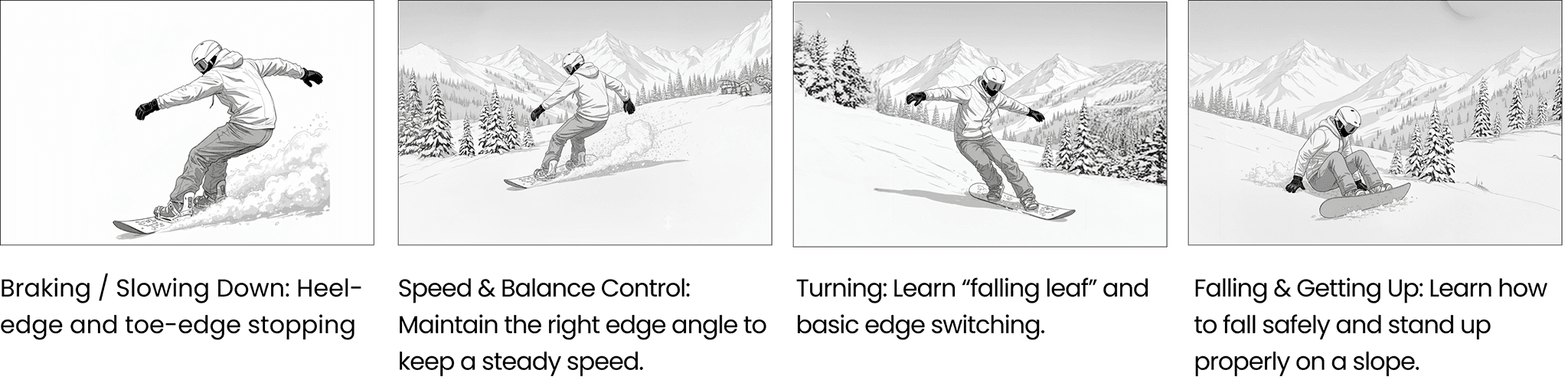
Core Skills
To overcome these fears, beginners must first master a few fundamental snowboarding skills — the key to staying safe and confident on the slopes.
Core Skills
To overcome these fears, beginners must first master a few fundamental snowboarding skills — the key to staying safe and confident on the slopes.
Core Skills
To overcome these fears, beginners must first master a few fundamental snowboarding skills — the key to staying safe and confident on the slopes.
Core Skills
To overcome these fears, beginners must first master a few fundamental snowboarding skills — the key to staying safe and confident on the slopes.
Current Solutions & Challenges
Current Solutions & Challenges
Current Solutions & Challenges
Current Solutions & Challenges
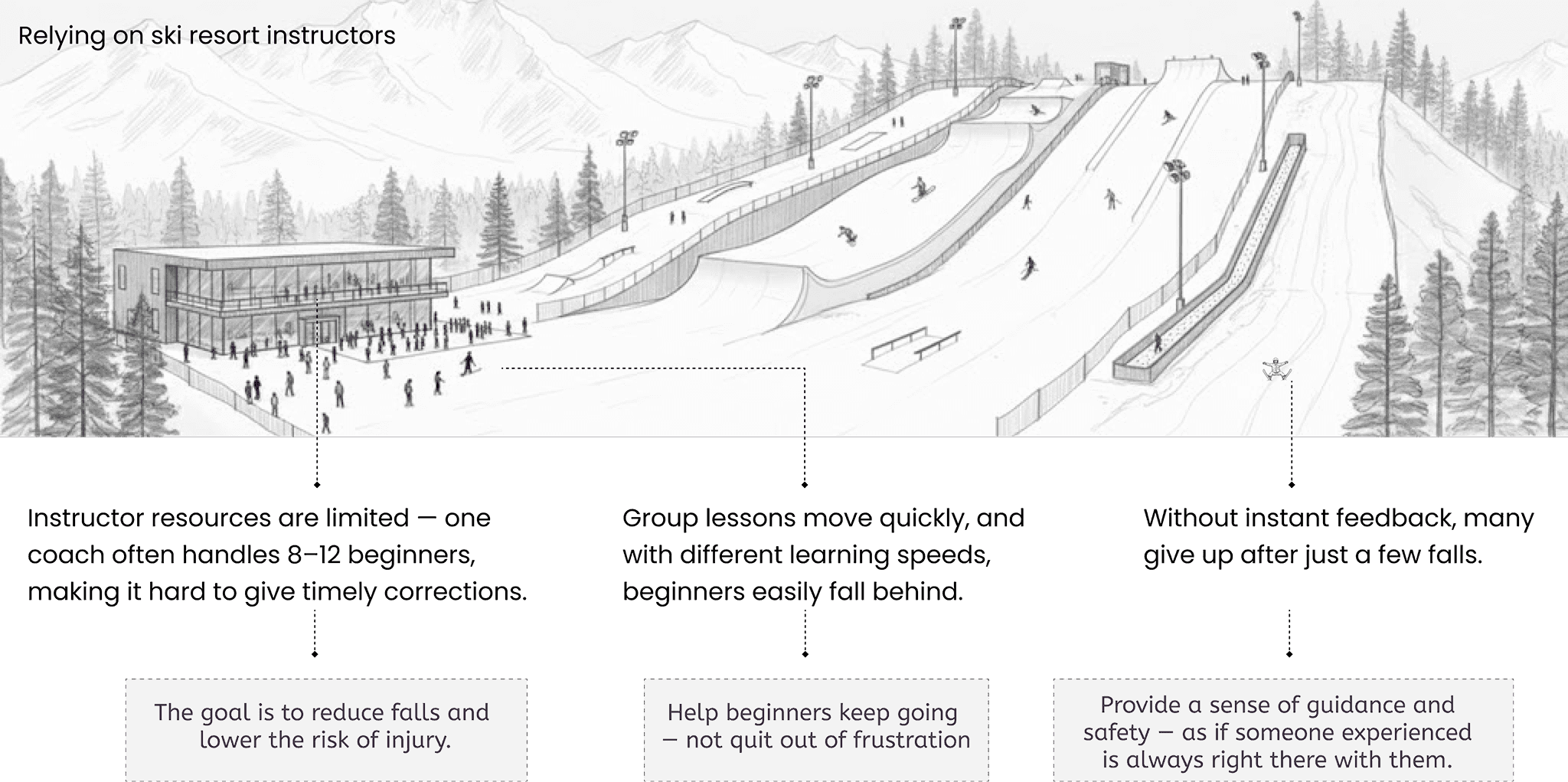
Design Aim
Therefore, I aim to design a snowboard assist system for beginners to improve their learning and overall experience.
Design Aim
Therefore, I aim to design a snowboard assist system for beginners to improve their learning and overall experience.
Design Aim
Therefore, I aim to design a snowboard assist system for beginners to improve their learning and overall experience.
Design Aim
Therefore, I aim to design a snowboard assist system for beginners to improve their learning and overall experience.

Snowboard Basics
During beginner training, most snowboarders adopt a forward-facing stance (used by over 70% of beginners). Therefore, the following angle analysis is based on this stance.
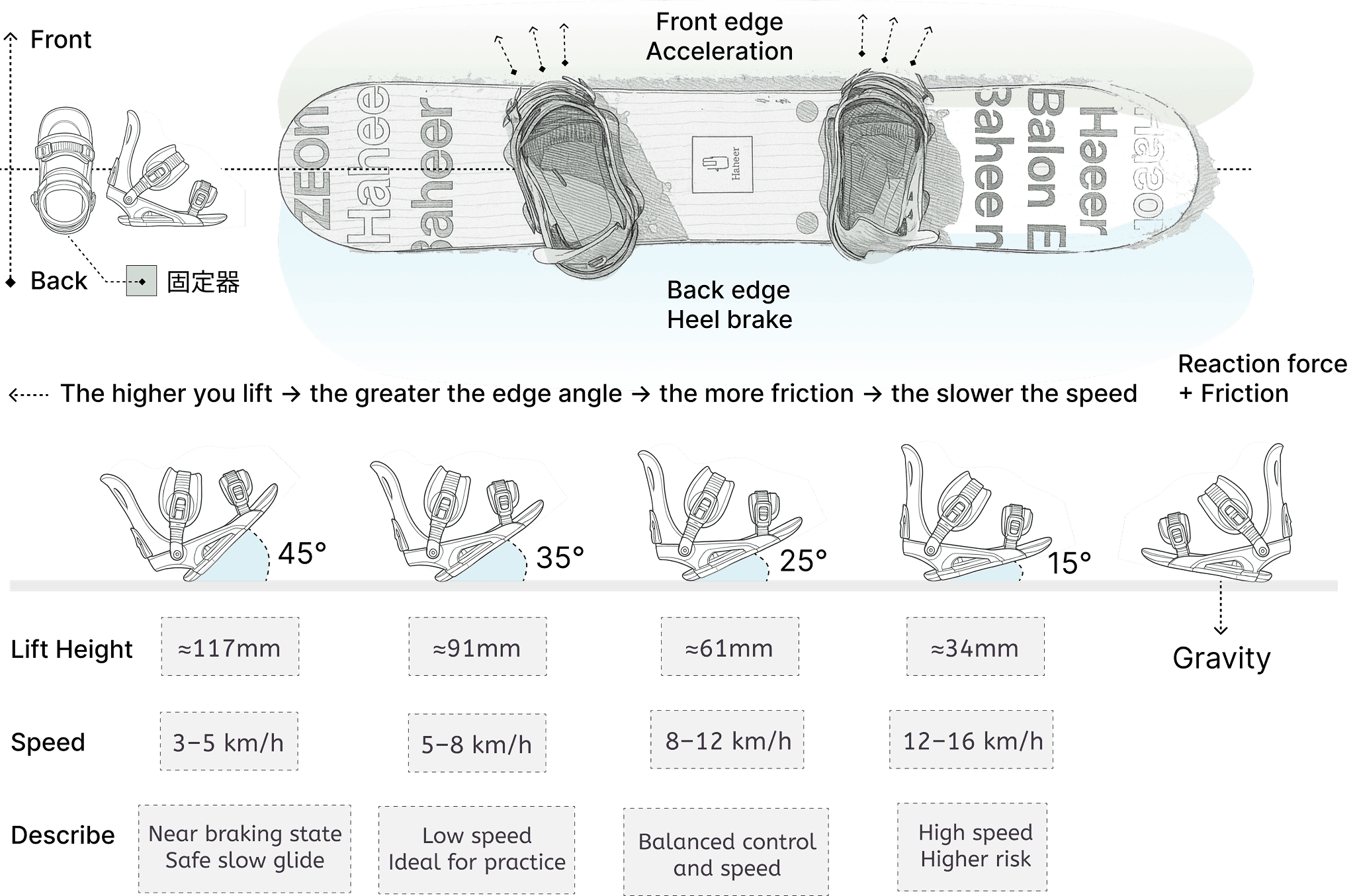
Gravity pulls the body downward, while the snow surface provides a normal force and the board’s edge creates friction. These three forces determine the snowboard’s direction and speed.
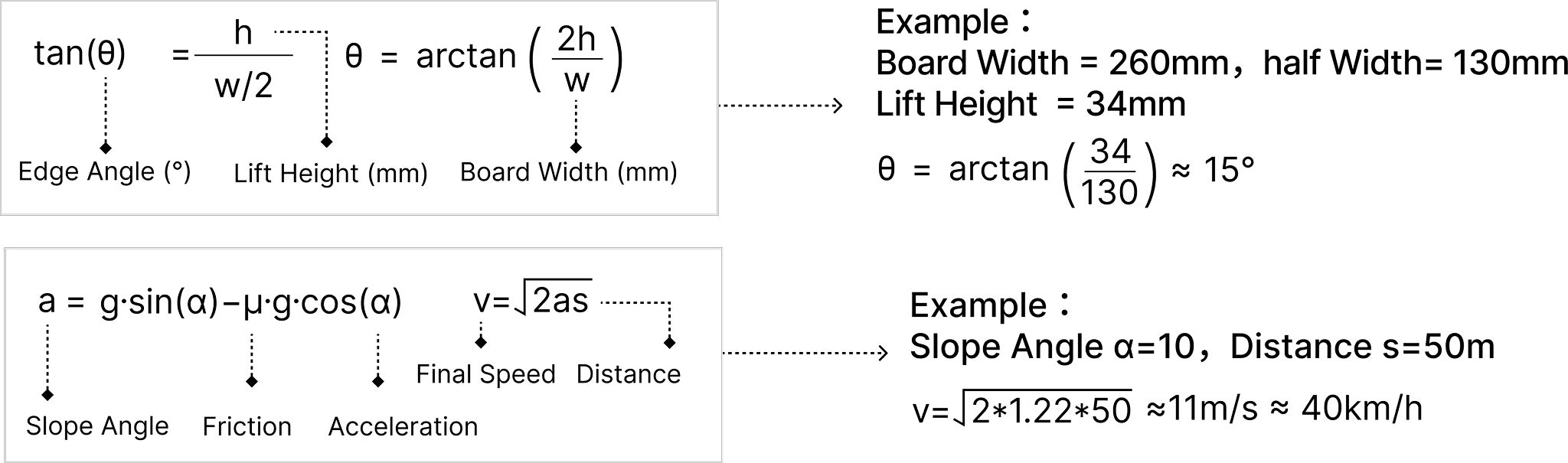
Larger edge angle → higher friction → slower speed
Steeper slope → stronger gravitational pull → faster speed
Turning Mechanism
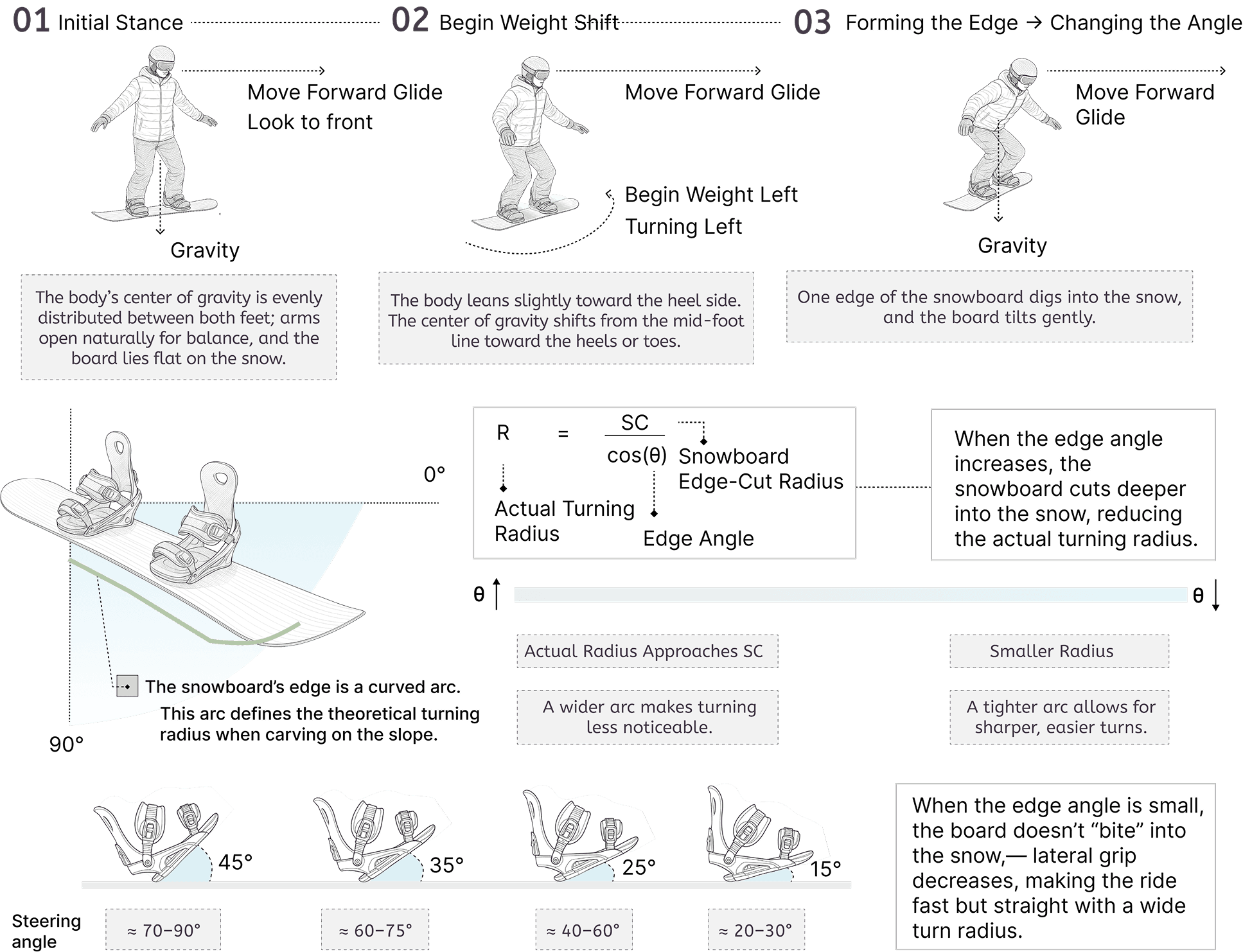
Beyond speed control, edge angle is one of the biggest challenges for beginners — many struggle to turn smoothly. In snowboarding, changing the angle isn’t about using your arms or isolated force — it’s about shifting your center of gravity and full-body posture.
Snowboard Basics
During beginner training, most snowboarders adopt a forward-facing stance (used by over 70% of beginners). Therefore, the following angle analysis is based on this stance.
Gravity pulls the body downward, while the snow surface provides a normal force and the board’s edge creates friction. These three forces determine the snowboard’s direction and speed.
Larger edge angle → higher friction → slower speed
Steeper slope → stronger gravitational pull → faster speed
Turning Mechanism
Beyond speed control, edge angle is one of the biggest challenges for beginners — many struggle to turn smoothly. In snowboarding, changing the angle isn’t about using your arms or isolated force — it’s about shifting your center of gravity and full-body posture.
Snowboard Basics
During beginner training, most snowboarders adopt a forward-facing stance (used by over 70% of beginners). Therefore, the following angle analysis is based on this stance.
Gravity pulls the body downward, while the snow surface provides a normal force and the board’s edge creates friction. These three forces determine the snowboard’s direction and speed.
Larger edge angle → higher friction → slower speed
Steeper slope → stronger gravitational pull → faster speed
Turning Mechanism
Beyond speed control, edge angle is one of the biggest challenges for beginners — many struggle to turn smoothly. In snowboarding, changing the angle isn’t about using your arms or isolated force — it’s about shifting your center of gravity and full-body posture.
Snowboard Basics
During beginner training, most snowboarders adopt a forward-facing stance (used by over 70% of beginners). Therefore, the following angle analysis is based on this stance.
Gravity pulls the body downward, while the snow surface provides a normal force and the board’s edge creates friction. These three forces determine the snowboard’s direction and speed.
Larger edge angle → higher friction → slower speed
Steeper slope → stronger gravitational pull → faster speed
Turning Mechanism
Beyond speed control, edge angle is one of the biggest challenges for beginners — many struggle to turn smoothly. In snowboarding, changing the angle isn’t about using your arms or isolated force — it’s about shifting your center of gravity and full-body posture.
03 IDEATION
After identifying beginners’ key challenges , I began exploring through sketches and early concepts how structural and wearable design improvements could enhance the snowboarding experience.
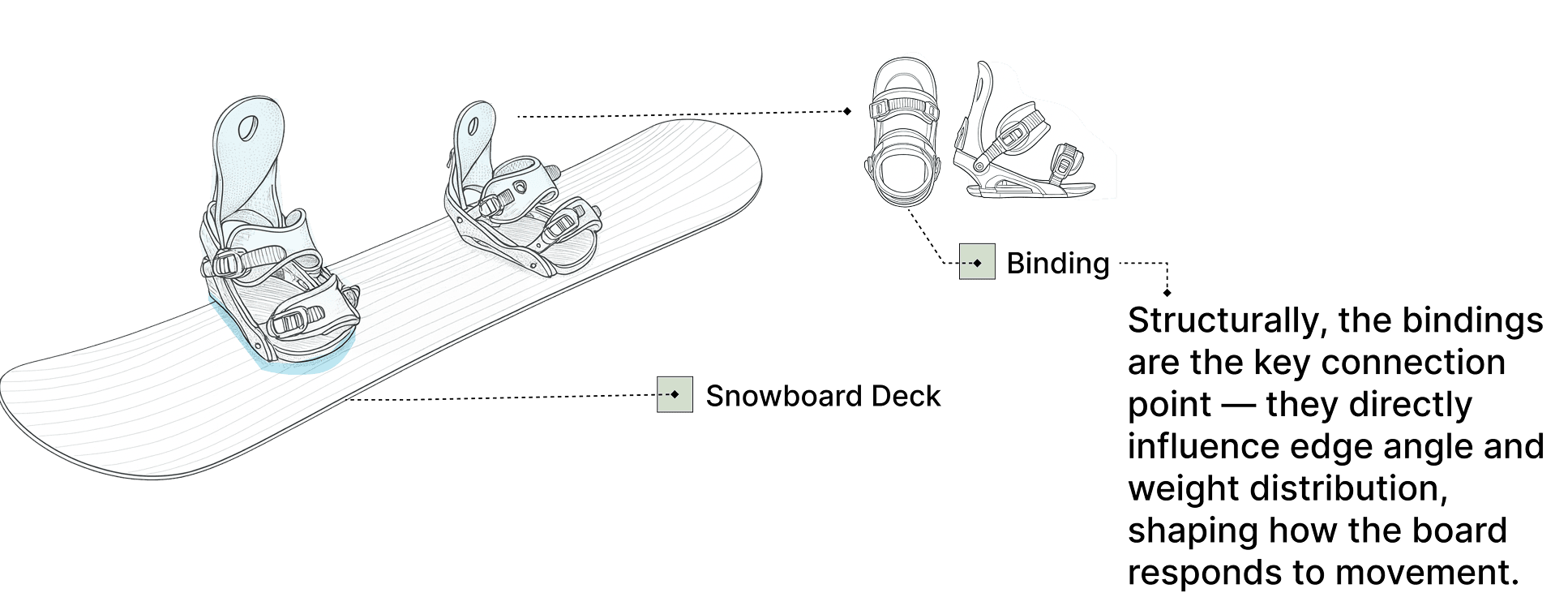
Snowboard Structure Analysis
The basic setup consists of the snowboard, bindings, and boots, where the bindings connect the rider to the board.
Wearable Control Analysis
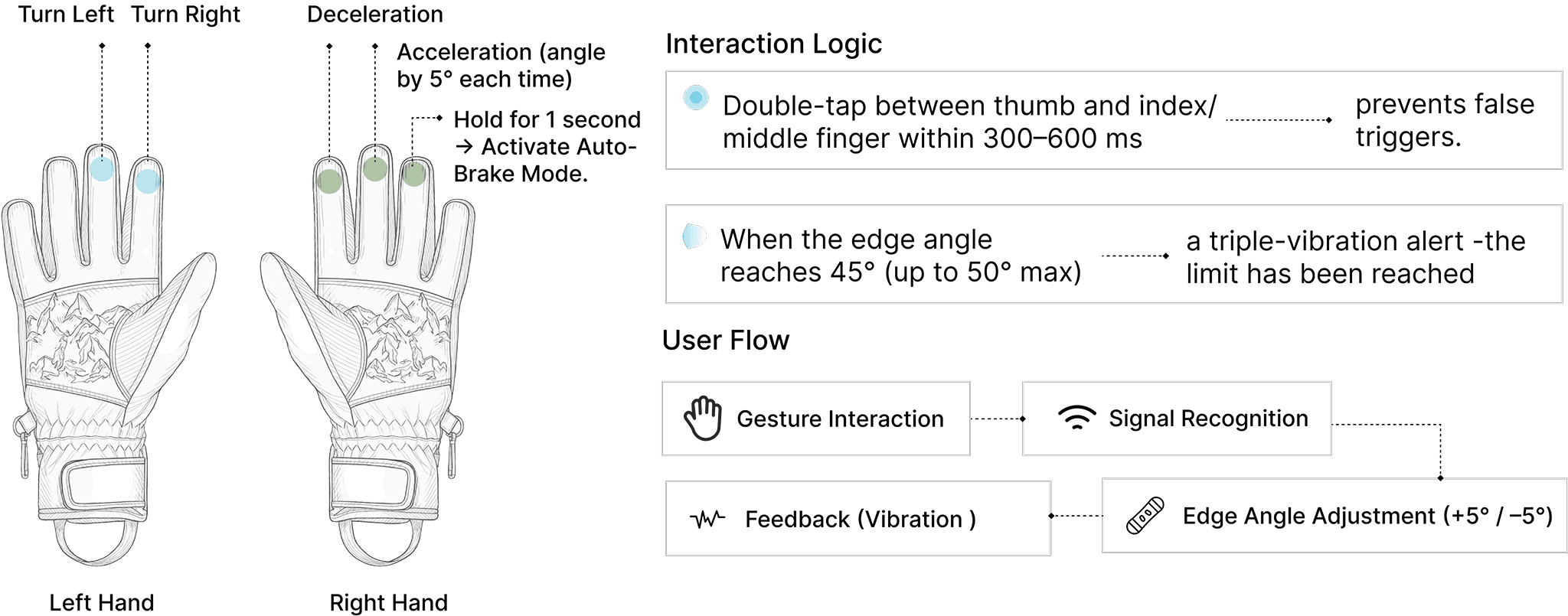
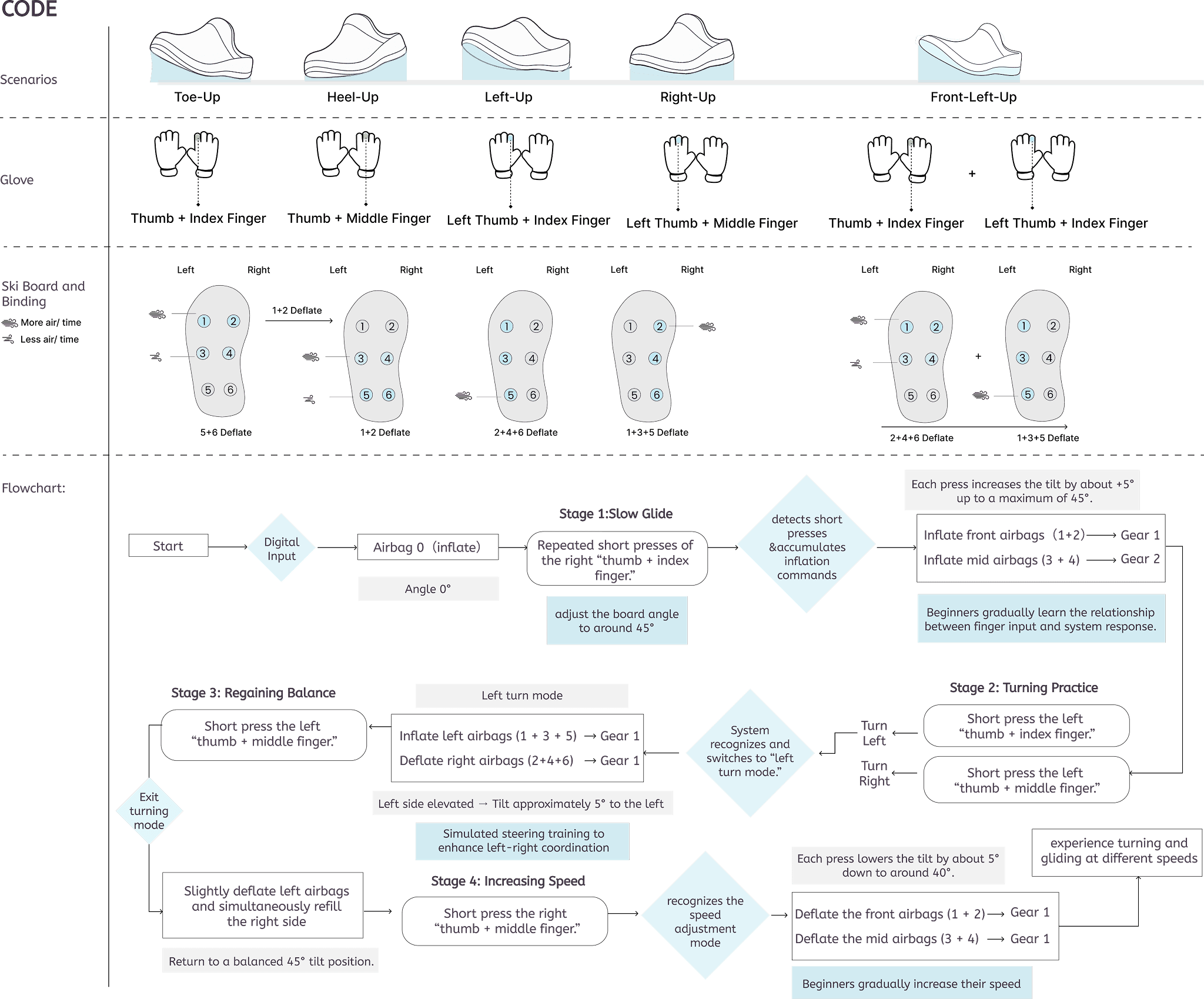
In addition to the board’s structural improvements, I designed a wearable glove control system that maps finger touch gestures to control edge angle and speed levels
After identifying beginners’ key challenges , I began exploring through sketches and early concepts how structural and wearable design improvements could enhance the snowboarding experience.
Snowboard Structure Analysis
The basic setup consists of the snowboard, bindings, and boots, where the bindings connect the rider to the board.
Wearable Control Analysis
In addition to the board’s structural improvements, I designed a wearable glove control system that maps finger touch gestures to control edge angle and speed levels
After identifying beginners’ key challenges , I began exploring through sketches and early concepts how structural and wearable design improvements could enhance the snowboarding experience.
Snowboard Structure Analysis
The basic setup consists of the snowboard, bindings, and boots, where the bindings connect the rider to the board.
Wearable Control Analysis
In addition to the board’s structural improvements, I designed a wearable glove control system that maps finger touch gestures to control edge angle and speed levels
After identifying beginners’ key challenges , I began exploring through sketches and early concepts how structural and wearable design improvements could enhance the snowboarding experience.
Snowboard Structure Analysis
The basic setup consists of the snowboard, bindings, and boots, where the bindings connect the rider to the board.
Wearable Control Analysis
In addition to the board’s structural improvements, I designed a wearable glove control system that maps finger touch gestures to control edge angle and speed levels
Control Mechanism
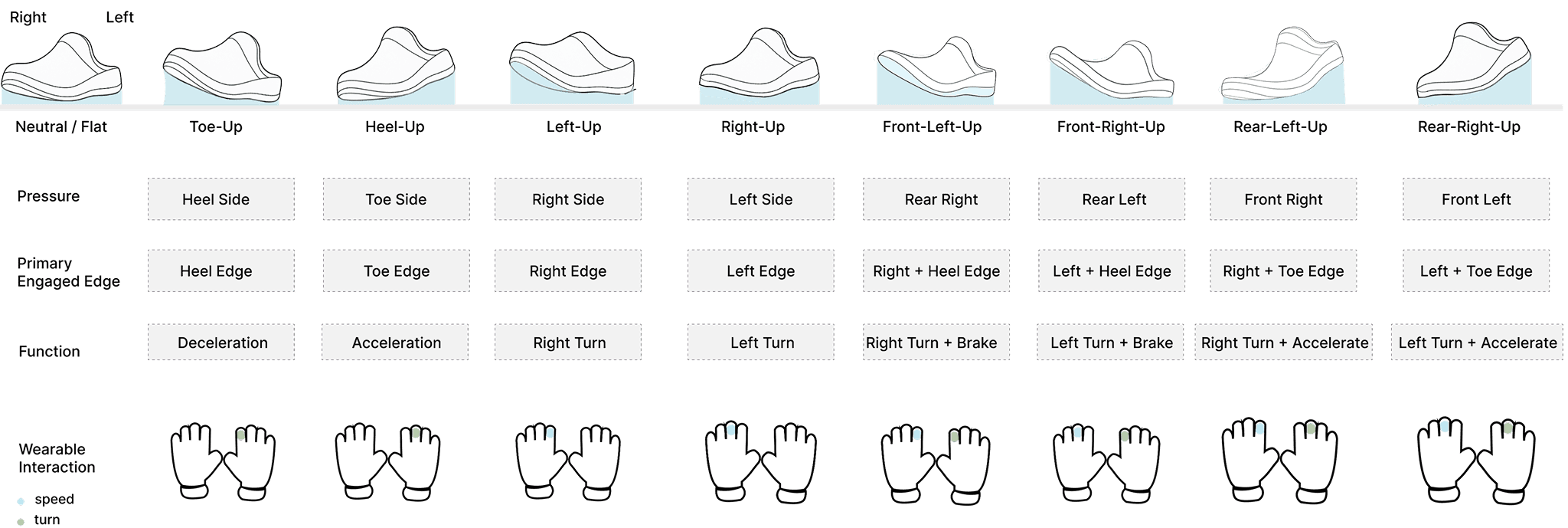
Snowboarding is primarily about shifting body weight to control speed and direction on the slope.
Control Mechanism
Snowboarding is primarily about shifting body weight to control speed and direction on the slope.
Control Mechanism
Snowboarding is primarily about shifting body weight to control speed and direction on the slope.
Control Mechanism
Snowboarding is primarily about shifting body weight to control speed and direction on the slope.
Slope Analysis & Learning Process
DESIGN AIM
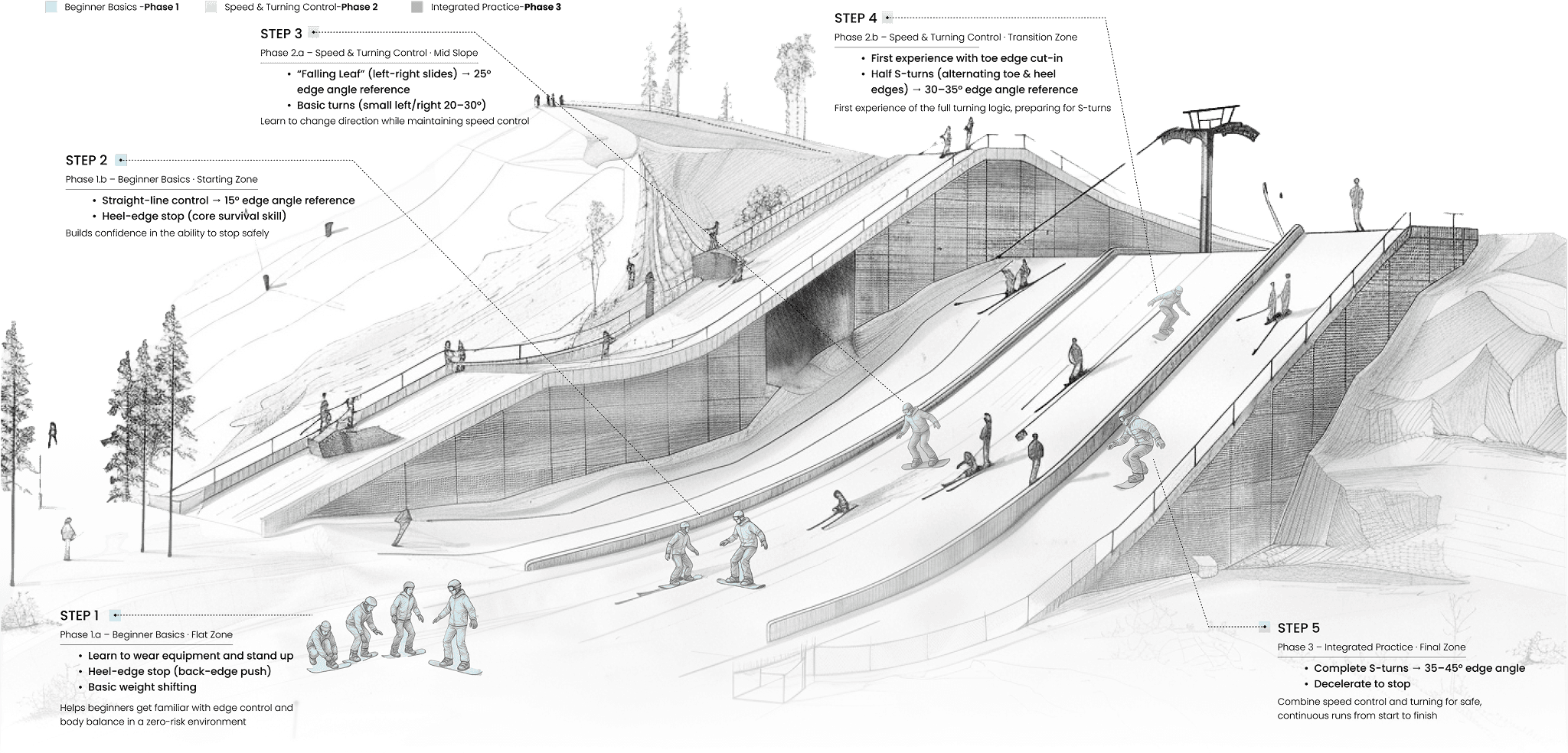
By dividing the ski slope into progressive training zones, beginners can practice specific skills on different gradients—building confidence and control step by step.
STUDY PROCESS

Slope Analysis & Learning Process
DESIGN AIM
By dividing the ski slope into progressive training zones, beginners can practice specific skills on different gradients—building confidence and control step by step.
STUDY PROCESS
Slope Analysis & Learning Process
DESIGN AIM
By dividing the ski slope into progressive training zones, beginners can practice specific skills on different gradients—building confidence and control step by step.
STUDY PROCESS
Slope Analysis & Learning Process
DESIGN AIM
By dividing the ski slope into progressive training zones, beginners can practice specific skills on different gradients—building confidence and control step by step.
STUDY PROCESS
04 DESIGN
Material in experiment

Process

Material in experiment
Process
Material in experiment
Process
Material in experiment
Process
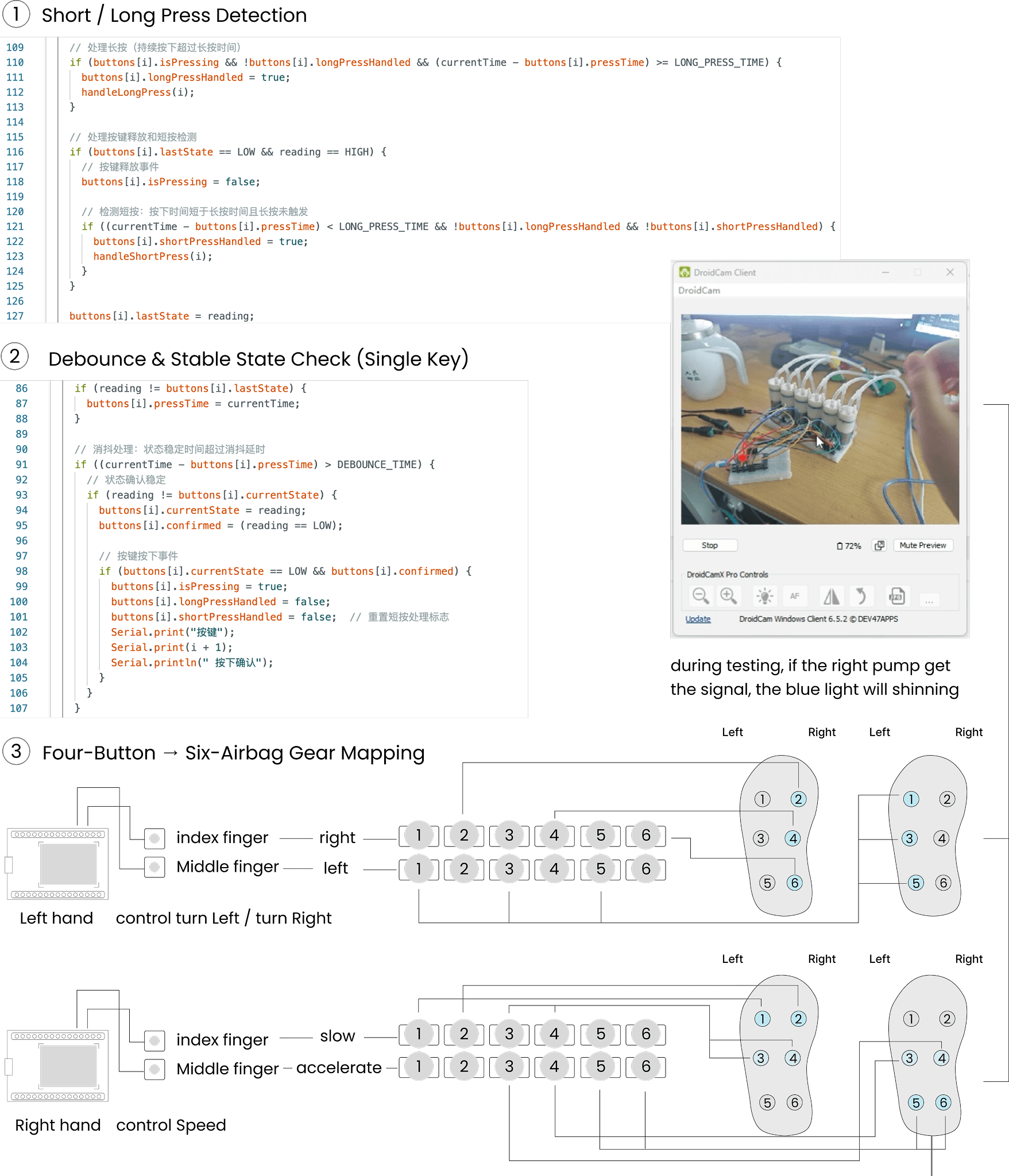
Button Test
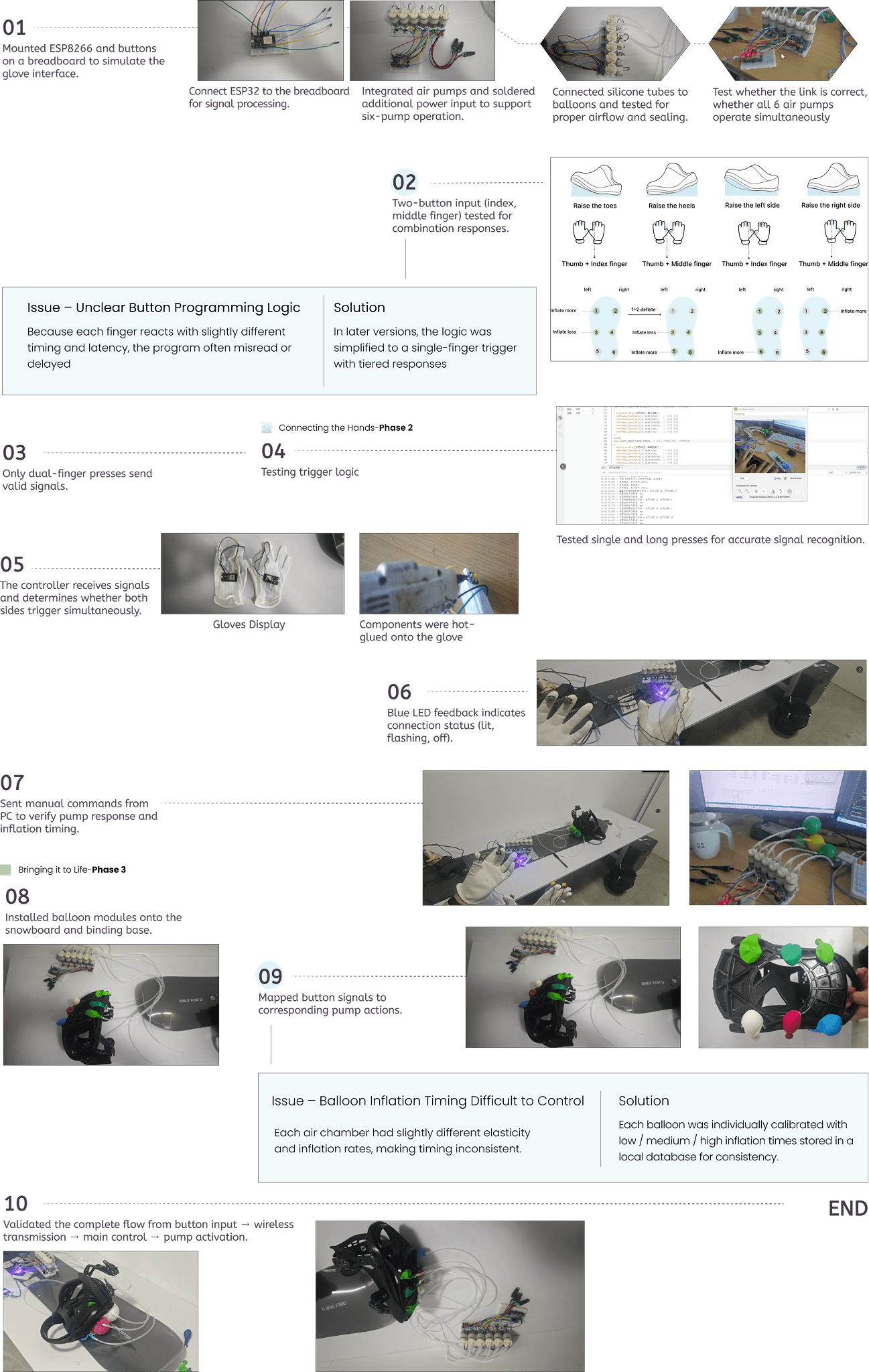
The button test detects single presses, translating them into gesture signals for control execution.
Short / Long Press Detection
Button Test
The button test detects single presses, translating them into gesture signals for control execution.
Short / Long Press Detection
Button Test
The button test detects single presses, translating them into gesture signals for control execution.
Short / Long Press Detection
Button Test
The button test detects single presses, translating them into gesture signals for control execution.
Short / Long Press Detection
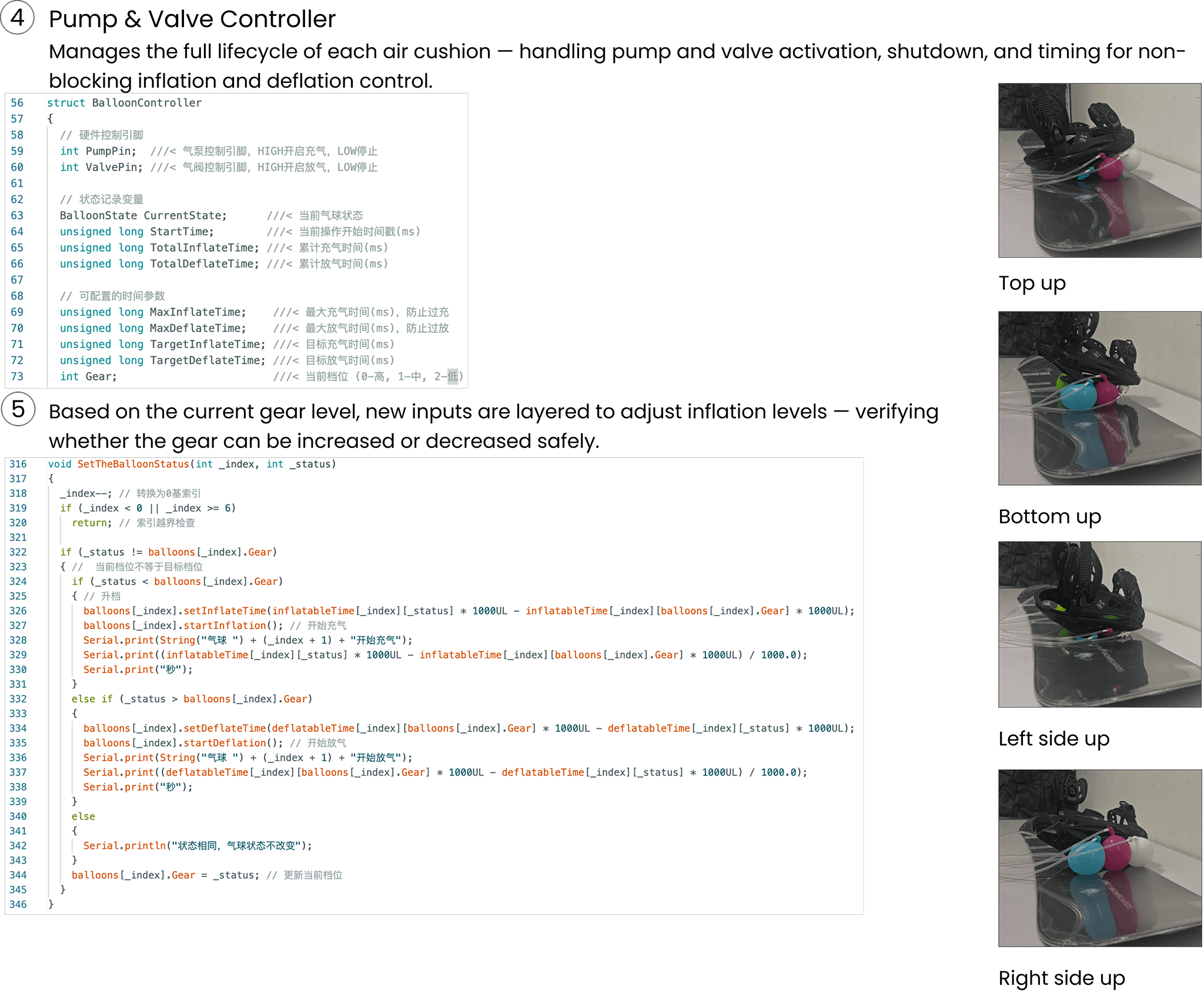
Pump Test
The pump test drives six air chambers with timed inflate/deflate cycles, validating gear mapping, safety limits, and leak behavior.
Pump Test
The pump test drives six air chambers with timed inflate/deflate cycles, validating gear mapping, safety limits, and leak behavior.
Pump Test
The pump test drives six air chambers with timed inflate/deflate cycles, validating gear mapping, safety limits, and leak behavior.
Pump Test
The pump test drives six air chambers with timed inflate/deflate cycles, validating gear mapping, safety limits, and leak behavior.
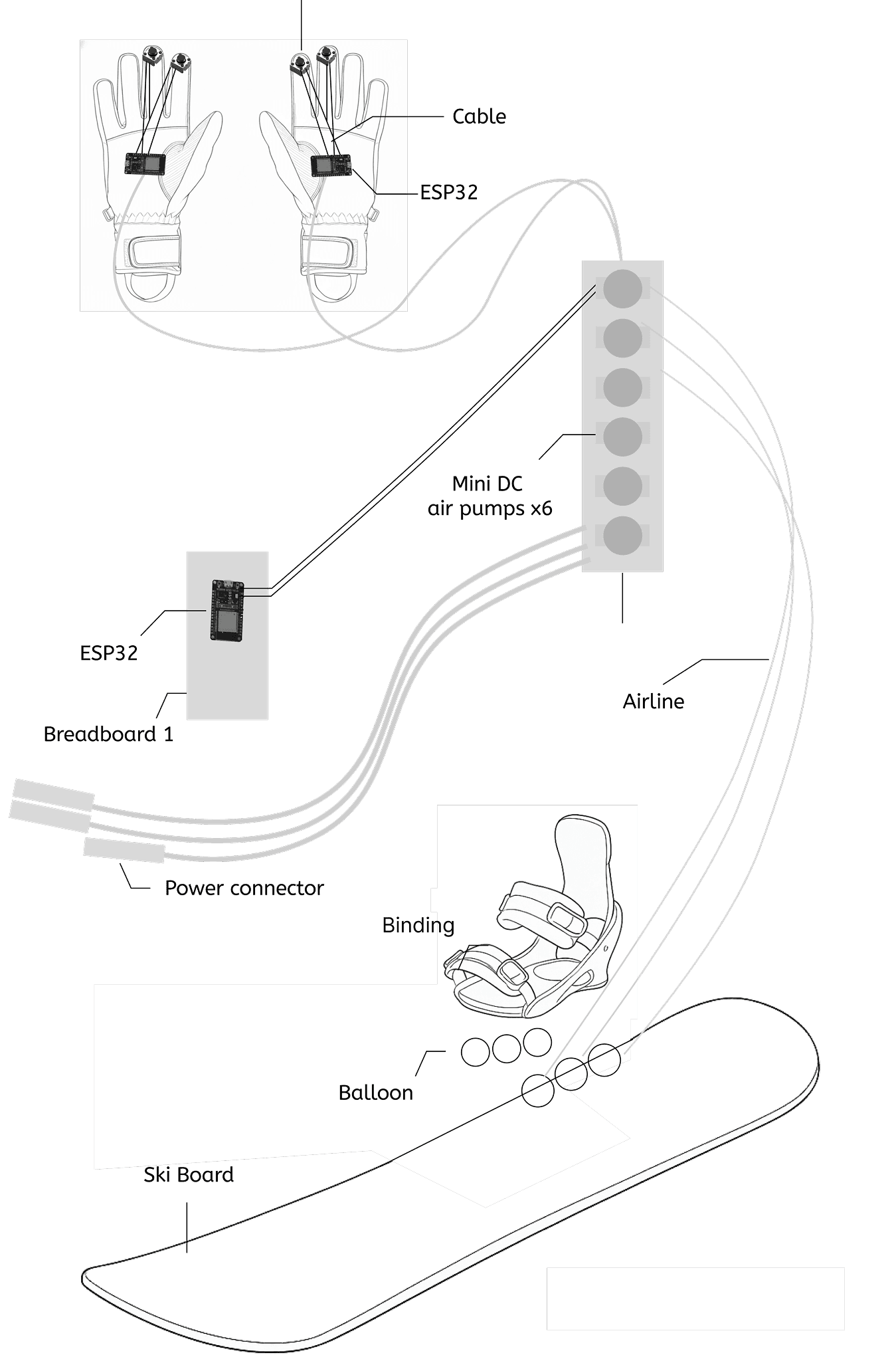
Connection method
The system transmits button signals from the glove to the main controller via ESP32 wireless communication, which controls six sets of mini DC air pumps beneath the snowboard. These pumps inflate or deflate air chambers in real time to adjust board tilt and direction.
Connection method
The system transmits button signals from the glove to the main controller via ESP32 wireless communication, which controls six sets of mini DC air pumps beneath the snowboard. These pumps inflate or deflate air chambers in real time to adjust board tilt and direction.
Connection method
The system transmits button signals from the glove to the main controller via ESP32 wireless communication, which controls six sets of mini DC air pumps beneath the snowboard. These pumps inflate or deflate air chambers in real time to adjust board tilt and direction.
Connection method
The system transmits button signals from the glove to the main controller via ESP32 wireless communication, which controls six sets of mini DC air pumps beneath the snowboard. These pumps inflate or deflate air chambers in real time to adjust board tilt and direction.
see also


.say hello
I’m currently exploring new opportunities for collaboration — whether in research, design, or creative practice
.say hello
I’m currently exploring new opportunities for collaboration — whether in research, design, or creative practice
.say hello
I’m currently exploring new opportunities for collaboration — whether in research, design, or creative practice
.say hello